
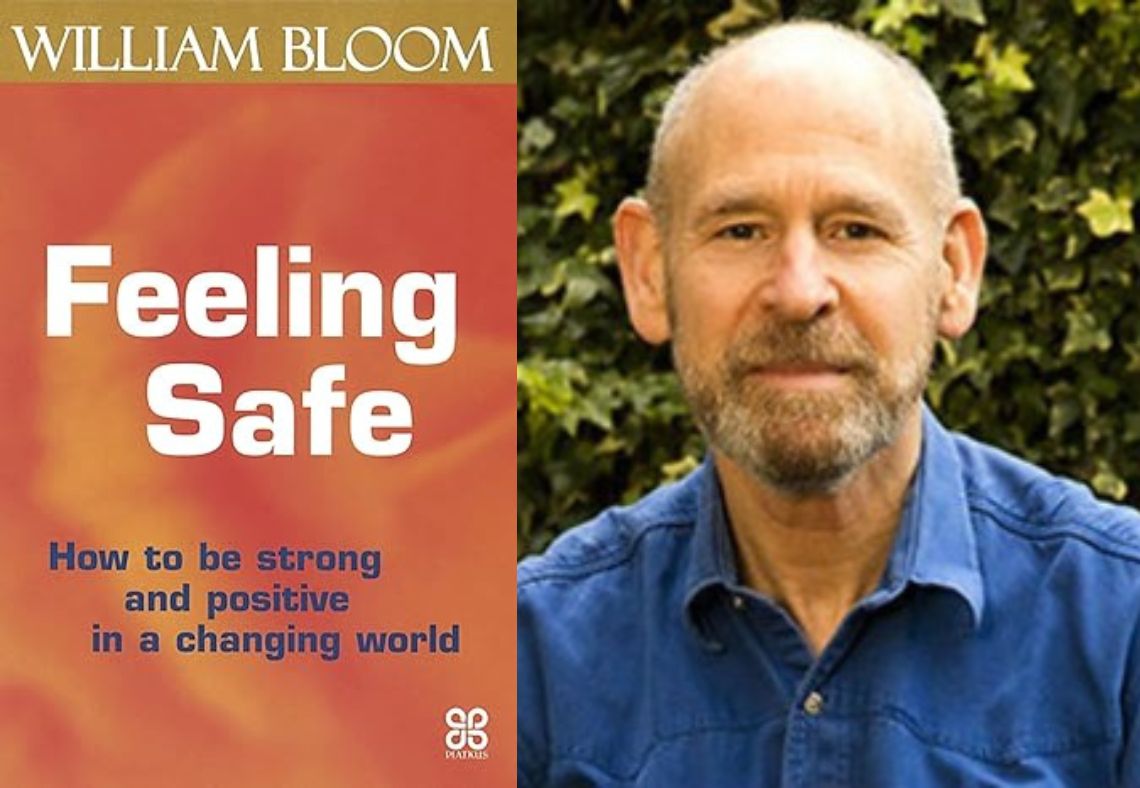
Feeling Safe by William Bloom
The physiology of joy
This excellent book is subtitled How to be strong and positive in a changing world: it’s a short, practical primer on techniques to raise your personal resilience.
William’s books inspire me by their skill in presenting ideas which are potentially complex or strange, in common sense mainstream language. Here, he explores the physiology of joy and resilience, along with personal energy fields, managing a hostile atmosphere, and lots more.
Part of the human problem is that we don’t realise the huge daily pressures we face. As William says, “Never before has humanity experienced such a relentless stream of shift, threat and stimulation… a tidal wave of endless and accelerating transformation.”
You’re probably familiar with fight-or-flight, and overstimulation of adrenalin. What’s new here is detailed advice on how to manage your own physiology: “The long-term key to a calm and safe body is to have an ongoing and healthy flow of …opiate hormones.” And key to this is “to take small moments of pleasure and to expand them into something stronger, longer and deeper.” He offers a simple technique he calls “strawberries” to achieve this, see more below.
William offers useful insights into handling negative feelings, pointing out that in our times there are huge collective fields of anger, fear, outrage, which can amplify our personal negative feelings. He advocates connecting to the benevolent, positive aspects of our own situation or the wider world as a counterbalance.
Strawberries and joy
One of my favourite methods in William’s book is what he calls strawberries: positive connections which you can pick up and take in when you need them. Here is an edited section of Chapter 3 on this topic:
“You might want to make lists of the things you love: people, animals, places, activities, objects, scents, colours, smells, tastes, spiritual teachers and icons. Highlight the things that will raise a smile from you even if you are in the worst of moods. It might be a grandchild, or a kitten, or a comedian.
“All the things on your list are powerful triggers for you. Even when you are tired or in a crisis, it will still be possible to withdraw from the world and give a few moments thought to these things you love. Even the shortest moment of focus on what you love and the tiniest flicker of an inner smile is better than an endless tunnel of depression.”
“Your experience of any situation is to a large degree dependent upon where you choose to focus. Give attention to what you do not like and you will create negative chemistry and feelings. Give attention to what you do like and you will create positive chemistry and feelings.
“It is important to get into the habit of noticing and using the positive triggers in your life. As well as making a list of everything you love in life, it is useful to place reminders in your environment and to surround yourself with things that give you pleasure. It is, for example, perfectly acceptable to have photographs of loved ones or images of sport of landscapes in a work place. If you work on a computer, you can use a screensaver that you particularly like. Next to your bathroom mirror where you brush your teeth, you can place a postcard of some favourite place, animal or person.”
“In times of crisis, stress and danger, what your body needs more than anything is the attention of your mind. Your body is like that of any other animal, and it will respond instinctively to the danger that it perceives and senses. You know this full well from those situations when you cannot control what your body is doing. You want to stay calm and act in a dignified way, but your biology is doing something you cannot control.
“In those moments, your body needs your attention. It is like a child needing reassurance from its parent. It is like a pet animal that needs stroking in order to be reassured. You will reassure your body if you turn your attention down into it and monitor how it feels.
“Focus down into your body. Immediately you create a neural connection between your mind/brain and your body. A neural message is communicated, ‘Hello there. I am your mind and I am giving you attention.’ In the same way that an anxious child finds comfort when a parent holds its hand, so the body is comforted by the attention of the mind, its internal parent.
“If you never read a page more of this book, then I would urge you to hang on to this one idea. If you are in any kind of stressful situation, turn your attention down into your own body. Withdraw your attention from external events and focus down into yourself. This will immediately inhibit the production of adrenaline and cortisol. It will block the production of those chemicals which create the feelings and sensations of tension and panic.
“It is very simple and easy. You can even do it while you are doing something else. Still reading this book, a part of you can focus down and become aware of how your body feels. This is how martial artists stay so calm in fights. There is always one part of the mind that stays aware of the body and calms it.
“It works particularly well if you take your focus down into the lower stomach. In fact, all martial arts exercises begin with students taking their mental focus down into the lower stomach and giving that area sustained attention. It is then useful to breathe softly and very deeply down into yourself. It also helps if you guide your chest and stomach muscles into relaxing, by allowing them to sink down.”
The stresses we all live with are more severe, more complex and more continual than ever before, so we have to keep making positive choices like remembering strawberries in order to sustain our capacity for joy.