
Eco-hamlets: a sane response to crazy times
Improving food security and affordable housing supply
There’s a widespread view that strengthening local communities will be crucial in the years ahead, to help us all to adapt to increasing levels of disruption, including food supplies, utilities, weather patterns, and more. One way to speed up this process is to create eco-hamlets, which would be a great way to help meet several urgent needs: for more local food production, for affordable housing, and to offer meaningful work and homes to young people who despair about the current situation.
Imagine a community of 10-20 people, with 8-20 acres of land enabling them to grow much of their food, and also to grow fast-rotation biomass for heating. It could use Tiny Homes, which are a more ecological and comfortable equivalent of mobile homes, and this could make planning permission a lot easier. These communities could use the cohousing approach, meaning that each personal household has their own private dwelling, but there are shared facilities, such as a large space for shared meals, meetings, teaching, parties, meditation, etc., along with guest rooms and workspaces.

The Lammas Ecovillage, Glandwr, near Crymych in Pembrokeshire, West Wales
Such communities would be a lot more resilient and sustainable than the way most of us live, and could share skills with their local area. They could provide a Community Supported Agriculture supply to people nearby, and increase local resilience in a range of ways. There are a number of projects along broadly these lines trying to start up around the UK. At present, there seems to be no umbrella network for these projects, and no single shared name.
However, there are encouraging signs of a number of planning authorities beginning to adopt policies which support this kind of project. Wales already has the One Planet Development policy, see more here, Powys has innovated in its approach, see more below, and Cornwall has recently adopted a policy to support Renewable Low-Impact Developments, see here. One of the prime movers behind this progress is James Shorten, a planning professional who is also a big advocate of regenerative settlements, which are very akin to eco-hamlets. His website, still in its early stages, could provide a catalyst for planning authorities and forming groups: see www.regenerativesettlement.com.
My five years living in a cohousing community (the Threshold Centre in Dorset, picture below) showed me that this can be a congenial way to achieve a low carbon footprint and high resilience. With a typical size being 20 to 50 adults, good levels of emotional and practical support emerge: for example, sharing childcare, cars, food growing, equipment, outings. Whilst no one can fully avoid the upheavals ahead, a cohousing eco-hamlet could lower its vulnerability a lot, for example through its own electricity and water supplies, food production and shared biomass heating. For more about cohousing, click here.
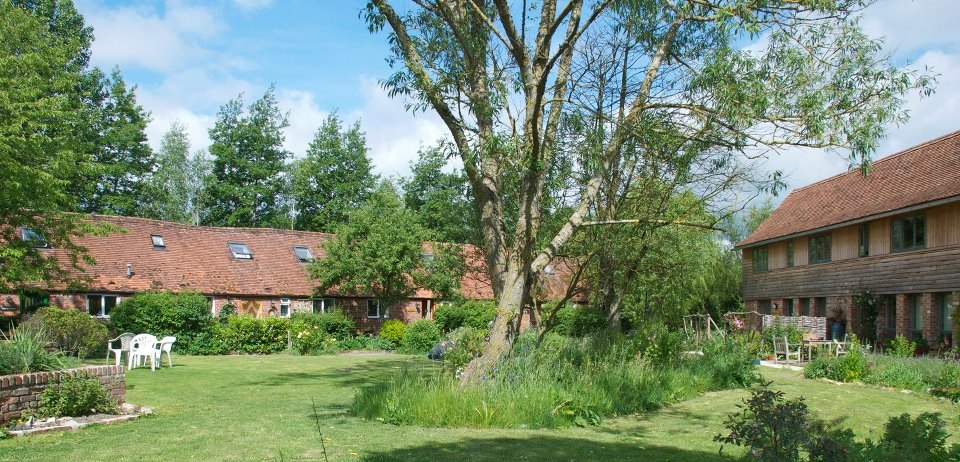
Cohousing is a congenial way to achieve a low carbon footprint
A Pilot in Powys?
There are several reasons why the county of Powys in mid-Wales could be a good location for a pilot eco-hamlet with a strong focus on food growing, including:
- Powys County Council is led by a progressive coalition of Liberal Democrats and Labour: their recent Rural Enterprise planning policy makes low-impact growing and dwellings more viable, and they have leased one of their farms to create pilot smallholdings at Sarn Farm.
- Our Food Trust is a dynamic non-profit aiming to increase food growing in Wales, and food resilience. They were prime movers in setting up Sarn Farm, and their expertise and contacts would be available to help an eco-hamlet to set up, especially in Powys.
- The Welsh Government is taking food security seriously, and offers various funding streams to support horticultural startups. See more here.
- An eco-hamlet in Powys would benefit from a range of people and organisations based here, including Alan Heeks and Seeding our Future, Black Mountains College, Bwyd Powys Food (the food partnership for Powys), and many others.
Resource Guide
Let’s unpack the main elements of the eco-hamlet idea:
Land: Finding a site will be a major issue, however… because tiny homes are moveable, a project could seek a 20- or 30-year lease, rather than buying outright. Some local authorities still own farms, so this is on e approach worth exploring. Or put the word out for a sympathetic landowner in your area.
Planning permission: Another major challenge. It will help if your project grows from the existing neighbourhood around your site, or at least has their support and understanding: well-intentioned pioneers parachuting in usually stir up strong resistance! Currently, planning policies in Wales are more supportive in principle of this approach, compared to England.
Tiny Homes: A Tiny Home is a dwelling of around 100 to 300 square feet, usually moveable, and usually hand-built with a high level of insulation. There seems to be no independent network for this sector: most information comes from fabricators, such as www.tinyhouse.co.uk, www.live.offgrid.co.uk, and many others. Various UK projects using Tiny Homes are at an early stage, such as https://www.tinyhousecommunitybristol.org/about-thcb. You can buy a Tiny Home for £20K upwards, or build your own!
Food production: there’s plenty of expertise and benchmark projects. The Landworkers’ Alliance provides training to help young people and others with the skills to start up a market garden. This website is also very relevant: www.communitysupportedagriculture.org.uk.
Cohousing: this approach is now quite well established and supported, in the UK and many other countries. See more at www.cohousing.org.uk, and www.communityledhomes.org.uk. Both of these websites can help you find a project, or recruit people for a new one.
We can see all through the sweep of history, and right now in the climate crisis, that humanity struggles to prepare for major impending challenges. Timing is one problem: a lot more floods, food shortages, power cuts and major storms are all likely in the next few years, but no one can say exactly when. What I am advocating here has nothing to do with escaping to the Hebrides or other extreme forms of prepping: eco-hamlets are a practical way to engage with the issues, and one which we can all learn from as problems increase.